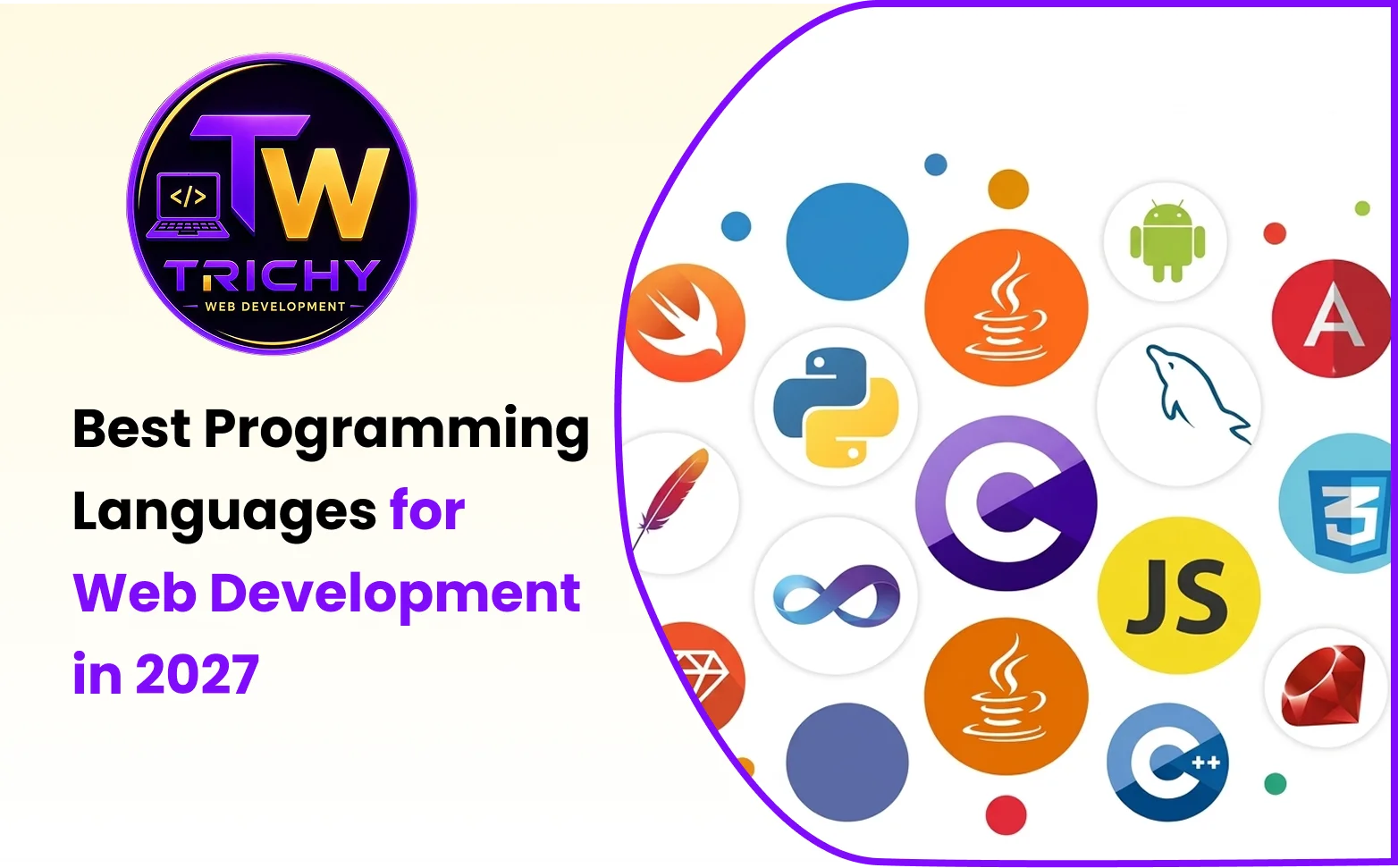
Choosing the right programming language is an important step when starting a web development project. With many languages available, it can be difficult to decide which one to learn or use. Some languages are better for building interactive websites, while others are useful for backend systems, business applications, and large-scale platforms.
The best programming languages for web development in 2027 will depend on your project requirements, development experience, performance needs, and future goals. JavaScript, TypeScript, Python, PHP, Java, C#, Go, Ruby, and Rust are all useful options for different types of projects.
In this guide, we will compare popular web development languages, explore their advantages and limitations, look at practical code examples, and help you choose the right language for your career or project.
Quick Comparison of the Best Web Development Languages in 2027
Before exploring each language, take a look at this comparison table. It will help you understand where each programming language is commonly used.
| Programming Language | Main Use | Best For | Learning Difficulty |
|---|---|---|---|
| JavaScript | Frontend and Backend | Interactive websites and full-stack applications | Easy to Moderate |
| TypeScript | Frontend and Backend | Large and structured web applications | Moderate |
| Python | Backend | APIs, web applications, and AI-powered platforms | Easy |
| PHP | Backend | Business websites and content management systems | Easy to Moderate |
| Java | Backend | Enterprise applications and large platforms | Moderate to Hard |
| C# | Backend | Business software and enterprise web applications | Moderate |
| Go | Backend | Cloud services and high-performance APIs | Moderate |
| Ruby | Backend | Rapid web application development | Easy to Moderate |
| Rust | Backend and Systems | Performance-focused services and secure systems | Hard |
Learning difficulty is a general estimate for beginners. Your experience with programming concepts can affect how quickly you learn each language.
1. JavaScript
JavaScript is one of the most important programming languages for web development. It helps developers create interactive elements that make websites more useful and engaging.
It runs directly in web browsers and can also be used on the server through technologies such as Node.js. This means developers can use JavaScript for both frontend and backend development.
What Can You Build with JavaScript?
-
Interactive business websites
-
E-commerce websites
-
Real-time chat applications
-
Online booking platforms
-
Dynamic dashboards
Advantages of JavaScript
-
Works in all major modern browsers.
-
Supports both frontend and backend development.
-
Has a large developer community.
-
Offers many libraries and frameworks.
-
Can be used for web and mobile application development.
Limitations of JavaScript
-
Large applications can become difficult to maintain without proper structure.
-
Developers need to understand asynchronous programming.
-
Browser differences may require additional testing.
Simple JavaScript Example
The following example shows how JavaScript can respond to a button click.
<button onclick="showMessage()">
    Click Here
</button>

<script>
function showMessage() {
    alert("Welcome to web development!");
}
</script>
When a visitor clicks the button, the browser displays a message.
When Should You Learn JavaScript?
JavaScript is a good starting point if you want to become a frontend developer or full-stack developer. It is also useful if you want to build interactive websites and web applications.
2. TypeScript
TypeScript is a programming language built on JavaScript. It adds static typing, which helps developers identify certain coding mistakes before running an application.
TypeScript code is compiled into JavaScript, so it works with existing JavaScript environments and browsers. It does not replace JavaScript; instead, it adds features that make larger projects easier to manage.
What Can You Build with TypeScript?
-
Large business applications
-
E-commerce platforms
-
Enterprise dashboards
-
Full-stack web applications
-
Complex frontend applications
Advantages of TypeScript
-
Helps identify errors during development.
-
Makes large codebases easier to maintain.
-
Provides better editor support and code suggestions.
-
Supports object-oriented programming.
-
Works with popular JavaScript frameworks.
Limitations of TypeScript
-
Beginners need to understand JavaScript first.
-
Type definitions can add extra work.
-
Developers need to understand the compilation process.
Simple TypeScript Example
function greetUser(name: string): string {
    return "Hello, " + name;
}

console.log(greetUser("Developer"));
Here, name: string tells TypeScript that the function expects a text value. This helps catch incorrect data types during development.
When Should You Learn TypeScript?
Learn TypeScript after understanding JavaScript basics. It is especially useful when working on large websites, team projects, and applications that need long-term maintenance.
3. Python
Python is a popular programming language known for its simple syntax and readability. It is widely used in web development, automation, data science, and artificial intelligence.
For web development, Python frameworks such as Django, Flask, and FastAPI help developers build websites, APIs, and backend systems.
What Can You Build with Python?
-
REST APIs
-
Content management systems
-
Data-driven websites
-
AI-powered web applications
-
Automation tools
Advantages of Python
-
Easy-to-read syntax.
-
Beginner-friendly learning process.
-
Supports several web development frameworks.
-
Useful for AI and data-related projects.
-
Has a large collection of libraries.
Limitations of Python
-
May require performance optimization for some high-traffic applications.
-
Memory usage can be higher than some compiled languages.
-
Choosing the right framework is important for project requirements.
Simple Python Flask Example
from flask import Flask

app = Flask(__name__)

@app.route("/")
def home():
    return "Welcome to Python Web Development!"

if __name__ == "__main__":
    app.run(debug=True)
This example creates a basic web application using Flask. When someone visits the home page, the application displays a welcome message.
Important: debug=True is suitable for local development only. Disable debug mode in production environments to avoid exposing sensitive application details.
When Should You Learn Python?
Python is a good choice if you are a beginner interested in backend development, automation, or AI-based applications. It is also useful for developers who want to work with data-driven platforms.
4. PHP
PHP is a server-side programming language used to build dynamic websites and web applications. It has been part of web development for many years and continues to support many business websites and content management systems.
Popular platforms and tools such as WordPress and Laravel use PHP.
What Can You Build with PHP?
-
Business websites
-
E-commerce platforms
-
Content management systems
-
Customer management systems
-
Online booking platforms
Advantages of PHP
-
Designed for server-side web development.
-
Supports popular frameworks such as Laravel.
-
Works with many hosting providers.
-
Has a large collection of libraries and tools.
-
Suitable for custom website development.
Limitations of PHP
-
Poor coding practices can make applications difficult to maintain.
-
Developers need to follow security best practices.
-
Some projects may require additional tools for modern application architecture.
Simple PHP Example
<?php

$name = "Web Developer";

echo "Welcome, " . $name . "!";

?>
This example stores a name in a variable and displays a welcome message.
When Should You Learn PHP?
PHP is a useful option if you want to develop business websites, WordPress websites, or custom web applications. It is also worth learning if you want to work with Laravel.
5. Java
Java is a widely used programming language for enterprise software and large-scale applications. It is known for its strong object-oriented programming support and ability to run across different platforms through the Java Virtual Machine.
In web development, Java is commonly used with frameworks such as Spring Boot to build backend applications and APIs.
What Can You Build with Java?
-
Enterprise web applications
-
Banking platforms
-
Business management systems
-
REST APIs
-
Distributed applications
Advantages of Java
-
Supports large and complex applications.
-
Offers strong object-oriented programming features.
-
Has a mature ecosystem.
-
Provides tools for enterprise development.
-
Supports multithreading and backend processing.
Limitations of Java
-
Requires time to understand its concepts.
-
Can involve more code than some beginner-friendly languages.
-
Application setup may be complex for beginners.
Simple Java Example
public class Main {
    public static void main(String[] args) {
        String message = "Welcome to Java Web Development!";
        System.out.println(message);
    }
}
This simple program displays a message in the console.
When Should You Learn Java?
Java is a good option if you want to work on enterprise applications, large backend systems, or software platforms that require structured development.
6. C#
C# is a programming language developed by Microsoft. It is commonly used for enterprise software, web applications, cloud services, and desktop applications.
With ASP.NET Core, developers can use C# to build modern web applications and backend APIs.
What Can You Build with C#?
-
Enterprise web applications
-
Business management systems
-
Customer portals
-
REST APIs
-
Cloud-based applications
-
Internal company software
Advantages of C#
-
Strong support for object-oriented programming.
-
Works well with the .NET ecosystem.
-
Suitable for enterprise applications.
-
Provides useful development tools.
-
Supports modern web application development.
Limitations of C#
-
Beginners need time to understand the .NET ecosystem.
-
Some projects may require additional knowledge of Microsoft technologies.
-
Application architecture can become complex in large projects.
Simple C# Example
using System;

class Program
{
    static void Main()
    {
        string message = "Welcome to C# Development!";
        Console.WriteLine(message);
    }
}
This example displays a message using C#.
When Should You Learn C#?
C# is worth learning if you want to develop enterprise software, business applications, or backend systems using Microsoft's .NET platform.
7. Go
Go, also known as Golang, is a programming language developed by Google. It is designed to support simple, efficient, and scalable software development.
Go is often used for backend services, cloud platforms, microservices, and systems that handle many requests.
What Can You Build with Go?
-
Backend APIs
-
Cloud-based applications
-
Microservices
-
Distributed systems
-
Developer tools
-
High-performance web services
Advantages of Go
-
Simple language structure.
-
Built-in support for concurrency.
-
Fast compilation.
-
Useful for cloud-native development.
-
Suitable for scalable backend services.
Limitations of Go
-
Has a smaller collection of web frameworks than some older languages.
-
Developers need to understand concurrency concepts.
-
May not be the first choice for every type of website.
Simple Go Example
package main

import "fmt"

func main() {
    fmt.Println("Welcome to Go Web Development!")
}
This program displays a message using Go.
When Should You Learn Go?
Go is a good option if you want to work on cloud services, backend APIs, microservices, or applications that need efficient request handling.
8. Ruby
Ruby is a programming language known for its readable syntax. It is commonly used for web application development through the Ruby on Rails framework.
Ruby on Rails provides tools and conventions that help developers build web applications without creating every feature from the beginning.
What Can You Build with Ruby?
-
Startup web applications
-
SaaS platforms
-
Online marketplaces
-
Business management tools
-
Web application prototypes
-
Content-based platforms
Advantages of Ruby
-
Readable and beginner-friendly syntax.
-
Ruby on Rails supports rapid development.
-
Provides built-in conventions for common tasks.
-
Useful for building web application prototypes.
-
Has an established development ecosystem.
Limitations of Ruby
-
May require performance optimization for some large applications.
-
Has a smaller overall developer ecosystem than JavaScript.
-
Hiring availability can vary by location and project.
Simple Ruby Example
name = "Web Developer"

puts "Welcome, #{name}!"
This example displays a welcome message using Ruby string interpolation.
When Should You Learn Ruby?
Ruby is useful if you want to build web applications quickly, explore startup development, or work with the Ruby on Rails framework.
9. Rust
Rust is a systems programming language designed to provide performance and memory safety. It is becoming an interesting option for developers working on performance-focused backend services and systems software.
Rust uses a strict ownership and borrowing system to help prevent several common memory-related problems.
What Can You Build with Rust?
-
Performance-focused backend services
-
Systems software
-
WebAssembly applications
-
Networking tools
-
Secure infrastructure components
-
High-performance APIs
Advantages of Rust
-
Strong memory safety features.
-
High performance.
-
Supports safe concurrency.
-
Useful for systems-level development.
-
Can be used for WebAssembly projects.
Limitations of Rust
-
Has a steep learning curve.
-
Ownership and borrowing concepts take time to understand.
-
May be more complex than necessary for simple websites.
Simple Rust Example
fn main() {
    let message = "Welcome to Rust Development!";
    println!("{}", message);
}
This program displays a message using Rust.
When Should You Learn Rust?
Rust is worth exploring if you are interested in systems programming, performance-focused services, or applications where memory safety is important. It is usually not the easiest first language for someone who only wants to build basic websites.
Best Frontend Programming Languages in 2027
Frontend development focuses on the part of a website that visitors see and interact with. It includes page layouts, buttons, menus, forms, animations, and other user interface elements.
The following technologies are important for frontend development.
| Language or Technology | Main Purpose | Common Use |
|---|---|---|
| HTML | Structures web pages | Headings, forms, images, and page content |
| CSS | Styles web pages | Layouts, colours, spacing, and responsive design |
| JavaScript | Adds interactivity | Menus, forms, dynamic content, and interactions |
| TypeScript | Adds static typing to JavaScript | Large frontend applications |
HTML and CSS are essential web technologies, but they are not programming languages in the same sense as JavaScript or TypeScript. They work together to create the structure and appearance of websites.
Which Frontend Language Should You Learn First?
Start with HTML and CSS to understand how web pages are structured and styled. Then learn JavaScript to add interactive features. Once you understand JavaScript, you can move on to TypeScript and a frontend framework.
Best Backend Programming Languages in 2027
Backend development handles the server-side operations of a website or application. It manages data, user accounts, authentication, business logic, database communication, and APIs.
The following languages are commonly used for backend development.
| Language | Common Frameworks or Tools | Suitable Projects |
|---|---|---|
| Python | Django, Flask, FastAPI | APIs, business applications, and AI-powered platforms |
| PHP | Laravel, Symfony | Business websites and custom web applications |
| Java | Spring Boot | Enterprise applications and large backend systems |
| C# | ASP.NET Core | Business software and enterprise platforms |
| JavaScript | Node.js, Express | APIs and full-stack applications |
| Go | Gin, Fiber | Cloud services and microservices |
| Ruby | Ruby on Rails | SaaS applications and web platforms |
| Rust | Actix Web, Axum | Performance-focused backend services |
Which Backend Language Should You Choose?
Your choice should depend on your application requirements.
-
Choose Python for readable code and a broad range of backend applications.
-
Choose PHP for business websites, Laravel applications, and WordPress development.
-
Choose Java for large enterprise systems.
-
Choose C# for applications built with the .NET ecosystem.
-
Choose JavaScript for full-stack development using one main language.
-
Choose Go for cloud services and scalable backend systems.
-
Choose Rust when performance and memory safety are important.
Frontend vs Backend: What Is the Difference?
Frontend and backend development have different responsibilities, but they work together to create a complete web application.
| Frontend Development | Backend Development |
|---|---|
| Handles the user interface | Handles server-side operations |
| Runs mainly in the browser | Runs on the server |
| Uses HTML, CSS, JavaScript, and TypeScript | Uses Python, PHP, Java, C#, Go, and others |
| Manages user interactions | Manages data and business logic |
| Displays information to visitors | Processes and provides information |
For example, when a customer submits an enquiry form on a business website, the frontend displays the form and collects the details. The backend validates the information, stores it in a database, and may send a notification to the business owner.
Both sides are important for building a complete website.
Best Programming Language Combinations for Full-Stack Development
Full-stack development involves working on both frontend and backend parts of an application. Developers can choose different language combinations based on project needs.
Here are some common combinations:
| Frontend | Backend | Suitable For |
|---|---|---|
| HTML, CSS, JavaScript | Node.js | Full-stack JavaScript applications |
| React, TypeScript | Node.js | Structured and scalable web applications |
| React, JavaScript | Python Django | Data-driven web applications |
| HTML, CSS, JavaScript | PHP Laravel | Business websites and custom platforms |
| React, TypeScript | Java Spring Boot | Enterprise web applications |
| Angular, TypeScript | C# ASP.NET Core | Business and enterprise systems |
Which Full-Stack Combination Is Best?
There is no single combination that works for every project.
For example, a business website with enquiry forms and an admin panel may work well with Laravel and JavaScript. A large enterprise application may need a different architecture using Java or C#.
Choose technologies based on the features, security needs, expected traffic, development team's experience, and long-term maintenance requirements.
What Do Recent Developer Surveys Say About Programming Languages?
Developer surveys can help us understand which languages developers are currently using. However, survey results should not be treated as a guarantee of which languages will be most popular in 2027.
The Stack Overflow Developer Survey 2026 reported the following usage figures for selected programming, scripting, and markup languages among respondents who reported extensive development work during the previous year.
| Language | Survey Usage |
|---|---|
| JavaScript | 62.0% |
| Python | 58.0% |
| TypeScript | 43.8% |
| Java | 27.6% |
| C# | 27.1% |
| Rust | 18.0% |
| PHP | 17.7% |
| Go | 16.5% |
| Ruby | 5.8% |
Source: Stack Overflow Developer Survey 2026. These figures represent survey respondents' reported development work, not the percentage of all websites built with each language.
The GitHub Octoverse 2026 report also showed strong activity around TypeScript and Python. TypeScript ranked first by contributor count, while Python ranked second. Between September 2025 and September 2026, TypeScript gained 3.62 million monthly contributors and Python gained 3.23 million.
These figures show that established languages continue to have an important role in software development. They also highlight the growing use of typed JavaScript and Python across different development projects.
Future of Web Development Languages: Trends to Watch in 2027
Web development continues to change as new tools, frameworks, and application requirements emerge. Instead of focusing only on which language is popular, developers should understand the technologies and skills that are shaping modern development.
Here are some important trends to watch in 2027.
1. AI-Assisted Development
AI tools can help developers explain code, generate basic functions, identify possible errors, and create test cases. These tools can support development work, but they do not remove the need to understand programming concepts.
Developers still need to review generated code, test application behaviour, and check security before using it in real projects.
2. Type-Safe Development
As applications become larger, maintaining code quality becomes more important. TypeScript and type systems in other languages help developers identify certain mistakes earlier.
This makes type-safe development useful for teams working on long-term applications.
3. Cloud-Native Applications
Many modern applications use cloud services, APIs, containers, and microservices. Languages such as Go, Java, Python, and JavaScript are used in different parts of these systems.
Understanding how applications communicate and scale is becoming an important development skill.
4. API-Based Development
Websites and applications often connect with payment gateways, CRM platforms, mobile apps, and other external services.
Developers need to understand REST APIs, authentication, data formats, and API security. Backend languages such as PHP, Python, Java, C#, and JavaScript can all be used to build APIs.
5. Web Performance and Security
Users expect websites to load quickly and work reliably. Developers need to understand performance optimization, secure coding, database queries, caching, and proper application architecture.
The programming language alone does not determine whether a website is fast or secure. How the application is designed and maintained also matters.
6. Strong Programming Fundamentals
Frameworks and AI tools may change, but programming fundamentals remain useful. Developers should understand variables, conditions, loops, functions, data structures, databases, error handling, and problem-solving.
These skills make it easier to learn new languages and work with different technologies.
How to Choose the Right Programming Language for Your Project
Choosing a programming language should start with understanding what you want to build.
Consider these factors before making a decision.
1. Understand Your Project Requirements
First, list the main features of your application. A simple company website may need different technologies from an online marketplace or a large business management platform.
2. Check Performance Requirements
If your application needs to handle many requests or complex processing, consider the performance requirements and the capabilities of the language and framework.
3. Consider Security
Your application may handle customer information, payments, or business data. Choose a technology stack that supports secure development and allows your team to follow proper security practices.
4. Check Developer Availability
Consider whether experienced developers are available to build and maintain the application. A technology with a strong developer community may make it easier to find support and resources.
5. Think About Future Maintenance
Your website may need new features, integrations, and improvements in the future. Choose a language and framework that your team can maintain as the application grows.
6. Consider Development Time and Budget
Some frameworks provide ready-made tools that help developers build common features faster. Compare the development effort, hosting requirements, and long-term maintenance costs before choosing a technology.
Best Programming Languages to Learn for Beginners in 2027
If you are new to programming, you do not need to learn every language. Start with one language based on your career goal and gradually expand your skills.
Here is a simple learning path.
Step 1: Learn HTML and CSS
Start by understanding how websites are structured and styled. Practise creating simple pages with headings, images, forms, and navigation menus.
Step 2: Learn JavaScript
After learning HTML and CSS, study JavaScript. Practise variables, functions, conditions, loops, arrays, and DOM manipulation.
Step 3: Choose a Development Path
Once you understand the basics, choose the area that interests you.
-
Frontend development: Learn JavaScript, TypeScript, and a frontend framework.
-
Backend development: Learn Python, PHP, Java, or another backend language.
-
Full-stack development: Learn frontend technologies and one backend language.
-
Enterprise development: Explore Java or C# based on the platforms you want to work with.
Step 4: Learn Databases
Understand how applications store and retrieve information. Start with SQL and practise using a database such as MySQL or PostgreSQL.
Step 5: Build Real Projects
Create small projects such as a portfolio website, enquiry form, task manager, or simple blog. Building projects helps you understand how different technologies work together.
Step 6: Learn Git and Deployment
Learn how to manage code with Git and GitHub. Then understand how to deploy an application to a hosting or cloud environment.
Step 7: Explore Frameworks
After learning the fundamentals, explore frameworks that match your chosen language. Frameworks provide reusable tools and structures for building applications.
Common Mistakes to Avoid When Learning Programming Languages
Learning a programming language takes practice. Beginners sometimes make mistakes that slow down their progress.
Avoid these common problems:
-
Learning too many languages at once: Focus on one language until you understand its fundamentals.
-
Skipping the basics: Learn variables, functions, loops, conditions, and data structures before moving to advanced topics.
-
Only watching tutorials: Practise by writing code and building small projects.
-
Ignoring debugging: Learn how to read error messages and find the cause of problems.
-
Depending completely on AI tools: Use AI to understand concepts and review code, but make sure you can explain and test the code yourself.
-
Ignoring security: Learn safe coding practices, input validation, authentication, and data protection.
-
Not building projects: Apply what you learn by creating websites and applications.
Conclusion
The best programming languages for web development in 2027 will depend on what you want to build and the skills you want to develop. JavaScript and TypeScript are useful for frontend and full-stack applications. Python and PHP are practical choices for many backend projects, while Java and C# support enterprise development. Go and Rust are worth exploring for specific performance-focused and cloud-related requirements.
If you are a beginner, start with HTML, CSS, and JavaScript. Then choose a backend language and learn how to connect your application with databases and APIs. Focus on building real projects instead of trying to learn every language at once.
The most important skill is not knowing the largest number of programming languages. It is understanding how to choose the right technology, solve problems, and build reliable web applications.