Blog Summary
Choosing between a custom website and a template website depends on business requirements, budget, functionality, branding, and future growth plans. Template websites offer a quicker and often more affordable starting point, while custom website development provides greater control over design, functionality, integrations, and scalability. Understanding the differences helps businesses select a website solution that supports both current operations and long-term objectives.
Quick Answer / Featured-Snippet Answer
A custom website is generally better for businesses that need unique functionality, specific workflows, advanced integrations, or long-term scalability. A template website is often suitable for businesses with limited budgets, standard requirements, and straightforward content needs. The right choice depends on the complexity of the project, available resources, and expected business growth.
Introduction
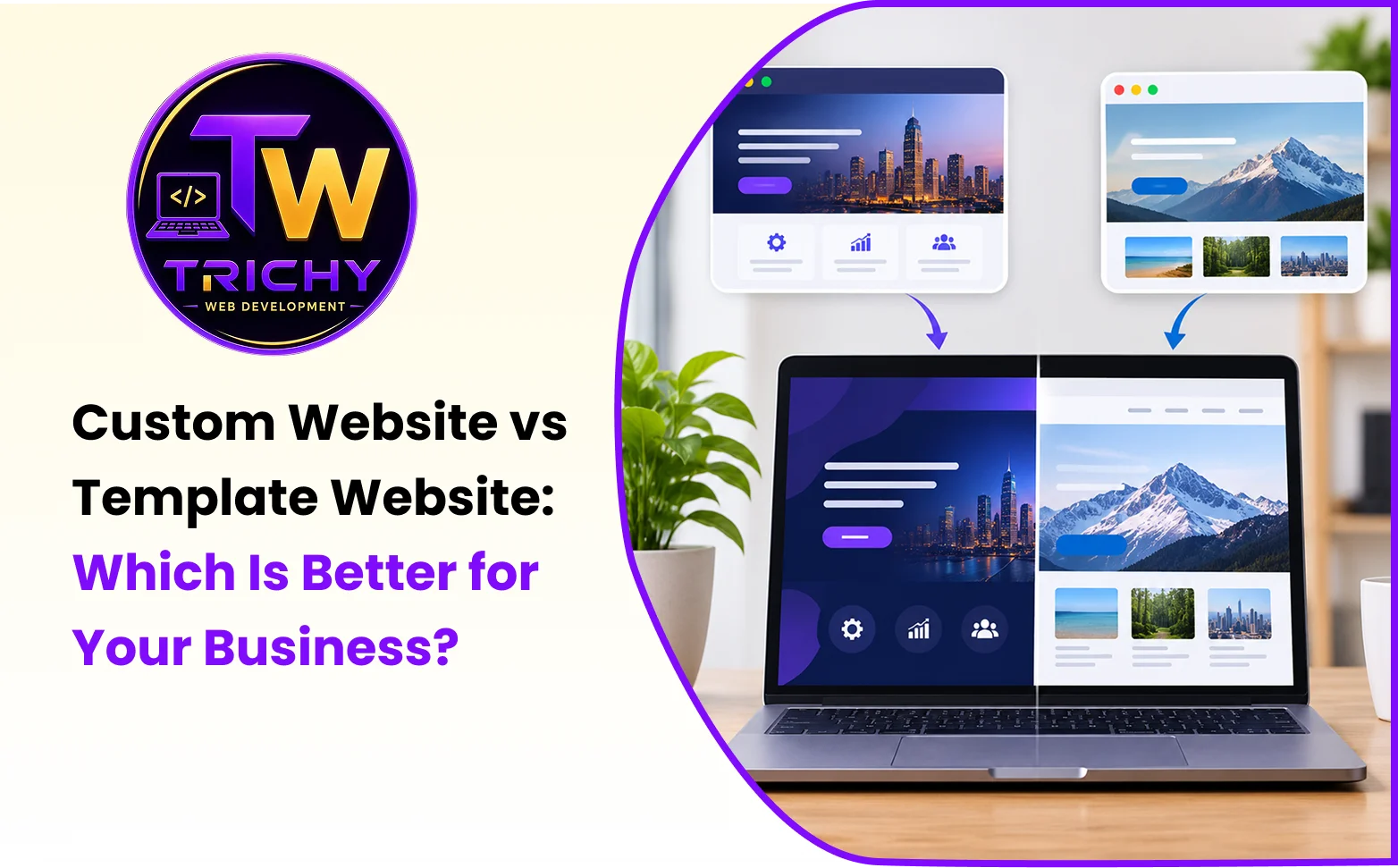
A business website is more than an online presence. It represents the brand, communicates services, attracts potential customers, supports enquiries, and sometimes handles important business operations. However, before starting website development, businesses face an important decision: should they choose a ready-made template or invest in a custom-built website? Both options can produce professional results, but they differ significantly in design flexibility, development approach, functionality, maintenance, and long-term adaptability. A template can help businesses launch quickly without building every component from the beginning. Custom development, on the other hand, allows the website to be planned around specific business requirements rather than adapting operations to an existing design. Understanding the differences between a custom website vs template website helps business owners make a practical decision based on what their website needs to accomplish today and how it may need to evolve in the future.
What Is a Custom Website and a Template Website?
Before comparing the two options, it is important to understand how each development approach works.
What Is a Custom Website?
A custom website is developed according to the specific requirements of a business. Its layout, design components, functionality, database structure, integrations, and user workflows can be planned around the intended purpose of the website.
For example, a manufacturing company may need a website with product catalogues, technical documentation, quotation requests, dealer access, and integration with internal business systems.
Instead of relying entirely on existing layouts or functionality, developers can create components that support these requirements.
Custom website development may involve technologies such as HTML, CSS, JavaScript, PHP, Laravel, databases, APIs, and other frameworks depending on the project.
What Is a Template Website?
A template website uses a pre-designed layout or theme that provides an existing visual and structural foundation.
Businesses can customize elements such as:
-
Logo and branding.
-
Website colours.
-
Typography.
-
Images and content.
-
Navigation menus.
-
Page sections.
-
Available template settings.
Ready-made website templates can reduce the amount of design and development work required.
They are particularly useful when a business needs a straightforward website with common features and does not require extensive customization.
Custom Website vs Template Website: Key Differences
The following comparison highlights the major differences between the two approaches.
|
Comparison Factor |
Custom Website |
Template Website |
|
Design |
Built around specific requirements |
Based on an existing layout |
|
Development |
Requires tailored development |
Starts with pre-built components |
|
Initial Cost |
Usually higher |
Often lower |
|
Launch Time |
Depends on project complexity |
Often faster |
|
Flexibility |
Greater control over functionality |
Limited by template structure |
|
Scalability |
Can be planned around future needs |
Depends on template and platform |
|
Integrations |
Can be developed for specific systems |
Depends on available compatibility |
|
Maintenance |
Depends on custom architecture |
Depends on platform and template |
|
Branding |
More control over unique presentation |
Customization within existing design |
|
Functionality |
Can support specific workflows |
Best suited to available features |
Neither option is automatically superior in every situation. The right approach depends on what the business expects from its website.
Custom Website Development: What Are Its Main Advantages?
Custom website development price guide allows businesses to build digital experiences around their actual operational and customer requirements.
Rather than selecting an existing design and adjusting business needs to fit it, developers can plan the website architecture according to the intended outcome.
Greater Design Flexibility
A custom website can use layouts, navigation systems, page structures, and visual elements designed specifically for the brand.
This is useful for businesses that need a distinctive digital identity or have complex content requirements.
Business-Specific Functionality
Custom development can support functionality that may not be available through a standard template.
Examples include:
-
Customer dashboards.
-
Booking and appointment systems.
-
Advanced product catalogues.
-
Quotation management.
-
Role-based user access.
-
Custom enquiry workflows.
Better Control Over Website Architecture
Developers can plan the structure around the website's actual requirements.
This includes database design, URL structure, reusable components, integrations, security controls, and content management workflows.
Room for Future Expansion
A custom-built website can be designed with anticipated business requirements in mind.
For example, a company starting with a service website may later need customer login, online payments, application tracking, or internal dashboards.
Planning for these requirements early can make future development more manageable.
Template Website Design: When Is It a Good Choice?
Template website design is a practical option when a business needs a professional online presence without requiring extensive custom functionality.
It can be suitable for:
-
Small business websites.
-
Basic service websites.
-
Personal portfolios.
-
Simple company profiles.
-
Landing pages.
-
Informational websites.
-
Early-stage business projects.
Faster Initial Development
Templates already provide common layout structures and components.
Developers can focus on customizing content, branding, navigation, and available functionality rather than creating every element from the beginning.
Lower Initial Investment
A template-based project may require fewer design and development hours, making it attractive to businesses working with limited budgets.
However, the final cost still depends on the platform, template licence, extensions, customization, hosting, and maintenance.
Existing Design Components
Templates often include common page sections such as headers, footers, banners, service cards, contact forms, and navigation elements.
These components can help businesses establish a website quickly.
Practical for Standard Requirements
When a website primarily needs to display company information, services, contact details, and basic content, a suitable template may provide everything required.
Custom Website Built vs Pre-Built Website: Which Offers More Flexibility?
A custom-built website vs pre-built website comparison becomes especially important when the business has requirements beyond standard pages.
Consider a company that wants to provide customers with:
-
Online registration.
-
Individual customer accounts.
-
Service request tracking.
-
Document uploads.
-
Automated notifications.
-
Payment processing.
-
Administrative dashboards.
A template may support some of these features through extensions or third-party tools. However, connecting all of them into one consistent workflow may require significant customization.
Custom development allows the application architecture and user journey to be planned around these requirements.
The decision should therefore be based on functional complexity rather than appearance alone.
Custom Website Design Benefits for Brand Identity
Custom website design benefits extend beyond choosing colours and adding a company logo.
A business website should communicate what makes the organization different.
A custom design can provide greater control over:
-
Brand presentation.
-
Visual hierarchy.
-
Navigation structure.
-
Content organization.
-
Customer journeys.
-
Conversion-focused page layouts.
-
Industry-specific presentation.
-
Reusable design components.
For example, a real estate company may need property search, location-based listings, enquiry forms, and property detail pages.
A training institute may need course listings, admission information, application forms, and student enquiry workflows.
Although both businesses need websites, their customers have different information requirements. A custom design can accommodate these differences more directly.
Custom Website Cost vs Template Website Cost
Cost is one of the most important considerations when selecting between the two options.
However, businesses should compare more than the initial development quotation.
Initial Development Cost
Template websites often have a lower starting cost because the design and some functionality already exist.
Custom websites generally require more planning, design, development, testing, and implementation.
Customization Cost
A template may become more expensive when the business needs extensive changes that the original design was not built to support.
Custom development includes more tailored work from the beginning, although changes outside the agreed scope can still increase the project cost.
Maintenance Cost
Both types of websites require maintenance.
This may include:
-
Security updates.
-
Bug fixes.
-
Hosting.
-
Backup management.
-
Performance monitoring.
-
Content updates.
-
Integration maintenance.
The actual maintenance cost depends on the technology, hosting environment, complexity, and support arrangement.
Long-Term Cost
A low initial price does not always mean a lower total cost.
If a business repeatedly pays for extensions, customizations, workarounds, or platform changes, the overall investment can increase.
Similarly, a custom website can become expensive if it is unnecessarily complex or poorly maintained.
The better comparison is the total cost of ownership over the expected life of the website.
Website Performance: Custom vs Template
Website performance depends on how the website is developed, hosted, and maintained.
A custom website can be designed to include only the components and functionality required by the project.
A template website may include additional scripts, styles, plugins, or components that the business does not use.
However, this does not mean every custom website is faster than every template website.
A poorly developed custom website can perform worse than a well-optimized template website.
Important performance considerations include:
-
Image optimization.
-
Efficient CSS and JavaScript.
-
Server response time.
-
Database query efficiency.
-
Caching.
-
Mobile responsiveness.
-
Core Web Vitals.
-
Third-party script management.
The quality of implementation matters more than the development label.
SEO Considerations: Which Website Type Is Better?
Neither custom websites nor template websites automatically receive better search rankings.
Search performance depends on content quality, technical implementation, website structure, usability, and relevance to search intent.
A well-built website should support:
-
Search-friendly URL structures.
-
Editable title tags and meta descriptions.
-
Logical heading hierarchy.
-
Crawlable internal links.
-
XML sitemaps.
-
Canonical URLs.
-
Structured data where appropriate.
-
Mobile-friendly layouts.
-
Fast-loading pages.
-
Accessible content structure.
Custom development can provide greater control over technical SEO implementation.
A template can also support effective SEO when it provides the necessary controls and is configured correctly.
Businesses should evaluate the actual technical capabilities of the solution instead of assuming one approach guarantees better rankings.
Scalability and Future Business Requirements
A website that works for a small business today may not support the same business after several years of growth.
For example, a basic service website may eventually need:
-
Multiple service locations.
-
Customer portals.
-
Online appointment scheduling.
-
Product or service subscriptions.
-
Advanced enquiry management.
-
CRM integration.
-
Payment gateways.
-
Automated business workflows.
Custom development can provide greater architectural control when these requirements are known or reasonably anticipated.
Template-based websites can also grow through plugins, extensions, and integrations, but their flexibility depends on the platform and available ecosystem.
Businesses should consider both current requirements and realistic future expansion plans.
Which Website Option Is Better for Different Businesses?
The most suitable choice depends on the business model.
Startups and Small Businesses
A template website may be sufficient when the main goal is to establish an online presence, explain services, and receive enquiries.
A custom website becomes more relevant when the startup's product or business model requires specialized functionality.
Professional Service Companies
A template may work well for a straightforward company profile.
Custom development may be more useful when the company needs appointment management, client portals, document workflows, or specialized enquiry systems.
E-Commerce Businesses
A template-based e-commerce platform may be suitable for a standard online store with common product and checkout requirements.
Custom development may be preferable when the store requires advanced product configurations, complex pricing, unique order workflows, or deep business-system integrations.
Manufacturing Companies
Manufacturers with product catalogues, dealer systems, quotation workflows, technical documentation, or ERP integration may benefit from a custom-built solution.
Educational Institutions
A basic informational website may work with a template, while student dashboards, admission management, course portals, and learning workflows may require more tailored development.
A SMART Framework for Choosing the Right Website
Businesses can evaluate their options using the SMART framework:
S — Scope Requirements
List the pages, functionality, integrations, and user workflows the website must support.
M — Match the Budget
Consider the initial development investment and the ongoing cost of hosting, maintenance, licences, and future changes.
A — Assess Flexibility
Determine whether an existing template can support the required functionality without excessive modifications.
R — Review Growth Plans
Consider whether the website may need additional services, users, integrations, or business workflows later.
T — Test Technical Capabilities
Evaluate performance, mobile responsiveness, security, SEO controls, accessibility, and maintainability before selecting the solution.
This framework helps businesses make a decision based on requirements rather than choosing only by price or visual appearance.
Common Mistakes Businesses Make When Choosing a Website
One common mistake is selecting a template based entirely on its appearance.
A visually attractive template may not support the functionality required by the business.
Another mistake is choosing custom development without defining clear requirements. This can lead to unnecessary features, longer timelines, and increased costs.
Businesses should also avoid assuming that custom development guarantees better performance or SEO.
Ignoring ongoing maintenance is another problem. Every website needs updates, monitoring, backups, and technical support.
Finally, selecting the cheapest option without considering long-term requirements can create avoidable redevelopment expenses.
Website Selection Checklist
Before deciding between a custom website and a template website, consider:
-
The purpose of the website.
-
The number and type of pages required.
-
The complexity of business workflows.
-
The need for custom functionality.
-
The expected number of users.
-
Required third-party integrations.
-
Product or service management requirements.
-
Available development budget.
-
Expected launch timeline.
-
SEO and performance requirements.
-
Security and access-control needs.
-
Future expansion plans.
-
Ongoing maintenance arrangements.
A clear requirement list makes it easier to compare proposals from website development providers.
How Professional Website Development Helps Businesses Choose the Right Solution
The choice between a template and custom development should begin with an understanding of the business rather than a technology preference.
A professional development process evaluates business objectives, target users, required functionality, content structure, technical requirements, budget, and future plans before recommending an approach.
For businesses considering a new website or redevelopment project, Trichy Web Development provides website development solutions that can be planned around business requirements, including design, functionality, integrations, and ongoing website needs.
Conclusion
Choosing between a custom website and a template website requires businesses to consider more than the initial design or development price. Template websites offer a practical starting point for standard requirements, faster launches, and limited budgets. Custom website development provides greater control over design, functionality, integrations, and business-specific workflows. Neither approach is universally better. A small company that needs a straightforward online presence may achieve its goals with a suitable template, while a business with complex operations or long-term digital expansion plans may benefit more from bespoke website development. The right decision comes from understanding current requirements, evaluating total ownership costs, and selecting a solution that can support the business without introducing unnecessary complexity.